Spinal Decompression in Tampa, FL
Spinal decompression at Lifehack Wellness Chiropractic is achieved by hand, through Advanced BioStructural Correction — not on a motorised traction table. The aim is the one every decompression method shares: reduce the compressive load sitting on discs and nerve roots. The route is different. Instead of pulling the spine lengthwise for thirty minutes, the segments that have drifted forward are corrected back into position, so the structure stops compressing itself in the first place.
If you searched for a decompression table in Tampa, this page explains what we do instead and why — including where a table genuinely has a place, so you can judge for yourself which one your situation calls for. The method behind it all is set out on our Advanced BioStructural Correction page.
Focus: Spinal Decompression
Location: Tampa, FL
Method: ABC™ Manual Correction
What a Visit Looks Like
What a Session Actually Involves
There is no equipment in this footage because there is none in the room. What you are watching is the corrective work itself — precise, brief contacts applied to segments that have travelled forward, in the one direction the body cannot produce for itself.
- Why the contact is short and specific rather than forceful
- What the audible release is — and why it measures nothing
The full appointment sequence is laid out on our first visit page.
What Decompression Actually Means
Strip away the marketing and spinal decompression describes one outcome: creating more room for structures that have too little of it. Discs sit under load. Nerve roots exit through openings between vertebrae. When that load rises or those openings narrow, the result is the familiar picture — pressure, ache, referred pain into a limb, symptoms that worsen the longer you stay upright.
There are two fundamentally different ways to produce more room, and confusing them is the source of most of the confusion around this term.
Distraction
- Pulls the spine lengthwise, mechanically, while the patient lies still
- Space increases during the session
- Gravity begins closing it again once they stand
Repositioning
- Returns segments that shifted forward to where they belong
- The column carries load again instead of the tissue around it
- This is the route taken here
Why the Distinction Matters
- Distraction treats a narrowed space
- Repositioning treats what narrowed it
- If nothing shifted structurally, distraction may be plenty
What both share: neither repairs disc tissue, and neither is appropriate before serious causes have been ruled out by examination. Any claim otherwise is overstated.
How the Compression Develops in the First Place
A lifetime of downward pull leaves a mark. Vertebrae migrate forward by small degrees, and the body compensates competently — tightening what it can tighten, redistributing what it can redistribute, letting the skull ride out in front so the horizon stays level.
Reversal, though, is not in the repertoire. There is no anatomical arrangement that tows a vertebra backward; every corrective mechanism you were born with pushes the same way the problem does. So a level that has migrated and settled quietly hands off its share of the work — to the disc below it, to the facet joints behind it, and to the openings where nerve roots make their exit.
That handed-off load is the compression. It also explains why pressure reappears after any treatment that opens space without altering position — the room was created, and the unchanged fault closed it again.
 A two-frame standing posture comparison used during an Advanced BioStructural Correction assessment at Lifehack Wellness Chiropractic in Tampa. Vertical reference lines mark how far the head and upper body sit forward of the body’s weight-bearing line, the measurement that identifies which spinal segments have drifted forward and can no longer self-correct.
How Decompression Is Produced Here
Four stages, in order, every time. Manual work occupies well under half an hour start to finish, with none of it spent on equipment.
1) Find Where Load Is Being Transferred
An examination of structure and movement pins down which levels have migrated, and how the column above and below them has reorganised itself in response.
2) Correct in the Direction the Body Cannot
Precise, low-force contacts move those segments rearward — the single direction no muscle of yours produces.
3) Release the Sleeve Around the Cord
Dedicated techniques target the membrane layers wrapping the spinal cord — a component standard adjusting does not include.
4) Measure It Again
Carriage, height, and available motion get retested at the end, so a result is something you can see rather than something you are told.
Brevity here is a property of the technique, not a corner being cut — and it is why people drive in from across the county without writing off an afternoon.
Where a Decompression Table Genuinely Fits
What Traction Does Well
It would be dishonest to suggest tables have no role. Mechanical traction has a real place, particularly under medical supervision for specific disc presentations, and plenty of people get meaningful relief from it. If you have been referred for it by a physician managing a diagnosed disc problem, follow that advice.
Medical care has no substitute in either route, and no single spine suits both.
Where It Stops Short
A table lengthens the spine while you are on it. It does not alter where an individual segment sits once you are upright and loaded again, and it does not address why the structure started transferring load in the first place.
Precisely that gap is what this approach exists to close, and it is why so many people arriving here have already tried tables and felt real relief that lasted a day or two apiece.
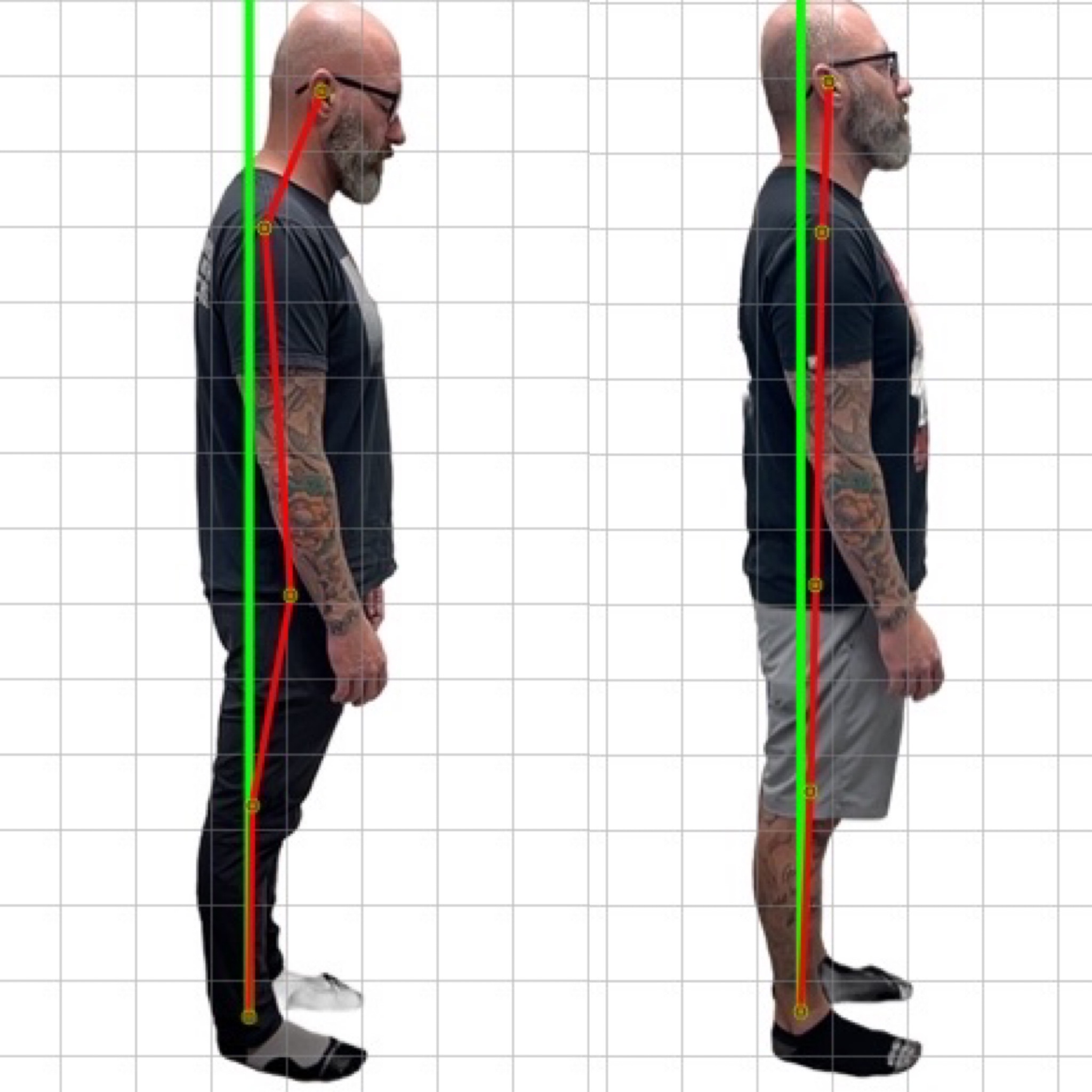 A recorded posture comparison from Lifehack Wellness Chiropractic in Tampa showing the change in standing alignment measured across a course of Advanced BioStructural Correction care. Posture markers are re-measured at checkpoints so structural change is observed rather than assumed. Individual results vary.
Who This Tends to Suit
- People carrying pressure or ache that builds the longer they stay upright and eases when they lie down
- People whose relief from traction, inversion, or hanging is real but expires within a day or two
- People whose symptoms sit alongside a head that rides forward and a rounded upper back
- People who have been told their imaging shows degenerative change and want the loading addressed rather than monitored
- People who would rather understand why the pressure keeps returning than manage it indefinitely
When Decompression Is Not the Answer
Go to Hospital Now
- Changes in bladder or bowel function, or numbness where you would sit on a saddle
- Intense pain straight after a serious fall or collision, while the area is still unimaged
See a Physician First
- Strength that is deteriorating — a leg giving way, or a toe you can no longer lift
- Spinal pain arriving with fevers, night sweats, or unintended weight loss, or in anyone with a cancer history
- Anything a doctor currently has under active treatment — their view comes first
Every one of those belongs with a physician before anyone puts hands on you. This work runs beside medical management; it is never the thing that replaces ruling something out.
Is Your Compression Tied to a Specific Cause?
Symptoms Running Down a Leg
Pain, tingling, or heaviness travelling below the buttock changes the assessment. Start with sciatica and joint pain care.
Booking, and What It Costs
The clinic is at 1355 W Gray St Suite B, Tampa, FL 33606, in South Tampa off Kennedy Boulevard, reached easily from the Selmon Expressway. Dr. Andy Xue is certified in the technique — a credential held by only a handful of practitioners across the state.
A first appointment covers the movement assessment, the three-dimensional rendering of your structure, and the treatment that follows from what they show. No insurance is billed here and no claims are submitted — you settle at the visit, card or otherwise. We publish no price list; phone the office and the current figure is yours immediately. What the visit contains is broken down on our page about chiropractic cost in Tampa.
Ask a Quick Question
Send the short version and Dr. Andy Xue’s team replies directly — usually the same day. Prefer to talk it through? Call 813-340-5708.
Spinal Decompression Questions — Answered Directly
Do you use a spinal decompression machine or traction table?
No. Decompression here is produced by hand, through Advanced BioStructural Correction. A motorised table creates space by pulling the spine lengthwise while you lie on it; this approach creates space by putting the segments back where they belong, so the compression is not reimposed the moment you stand up. Nothing in the visit involves waiting for a device to free up.
Is manual decompression as effective as a decompression table?
They are not really competing on the same ground, so the honest answer is that it depends on what is compressing the structure. Traction addresses the symptom of a narrowed space directly and temporarily. Structural correction addresses why the space narrowed. Where a level has migrated forward and settled, pulling along the length of the spine will not relocate it, and the relief tends to fade after each session.
Can this help a herniated or bulging disc?
It can help the mechanical loading around one, which for many people is what makes the difference day to day. It does not repair disc tissue, and nobody should tell you otherwise. Worsening weakness, numbness that is spreading, or any change in bladder or bowel function must be assessed medically before anyone treats you — no exceptions.
How long does a session take?
Treatment itself occupies well under half an hour. First appointments run longer, since your background, a safety screen, and a structural workup all precede any care. Nothing is padding the slot out — no half-hour strapped to a device, no filler modalities stretching it to the full hour.
Will I feel decompressed straight away?
Many people describe an immediate sense of lightness or of standing taller, which makes mechanical sense: once the column holds its own weight, whatever had been clenching to keep you vertical is free to stop. Even so, change at the structural level accumulates slowly and differs between individuals; no technique in this field can guarantee you a particular result.
Does insurance cover spinal decompression here?
No insurance is billed here under any circumstances. Appointments are settled directly, by card or otherwise. No billing code exists for the corrective and membrane-release work that generates the decompression, which makes a cash basis the straightforward position rather than a stance. Ask for current fees when you call and you will be told.
What Tampa Patients Are Saying
Over 1,000 structural transformations completed — 100% five-star reviews.
5.0 · 68 five-star Google reviews
★★★★★
I ditched my VA appointed chrio for Andy. Instant and lasting results, standing taller and less neck pain than ever, shoulders stay broader for longer and with less pain. Most traditional chiropractic offices you are with the doc for 5 mins at most sometimes less. Andy takes his time and is patient and extremely through with his techniques. He is the ONLY person to do ABC the tampa area, everyone else just cracks your back and lets you go. Andy is the complete opposite, he puts all the “traditional” chiropractic offices to shame.
Jonathan Nguyen · Google
★★★★★
I’ve been to many chiropractors & Andy is different! You can feel the immediate relief and the difference in your body. The ABC method was totally new to me- and I’m such a big fan!!! I highly recommend this for anyone who is looking to improve the way their body feels, looks, and works. After my appointments my training and muscle connection is so much better. Thank you!!
Elenoa McCabe · Google
★★★★★
I went to see Andy for my very first chiropractic session ever. I’ll be honest—I was a total skeptic. I wasn’t sure if chiropractic care was for me, or if it even worked. But after just one session with Andy, I was completely blown away. His approach is nothing like the traditional chiropractors you might imagine. Andy takes the time to explain everything, makes you feel completely at ease, and most importantly—you actually feel a difference right away. I felt so good after my first visit that I immediately signed up for 12 more sessions for myself AND 12 for my wife. Andy’s level of care, knowledge, and professionalism is on another level. If you’re in Tampa and even thinking about chiropractic care, do yourself a favor and book with Andy. I went from doubter to full believer in one visit—and I’m so glad I gave it a shot.
Jordian Perez · Google
Read More Patient Reviews
Find Us in Tampa
Lifehack Wellness Chiropractic — 1355 W Gray St Suite B, Tampa, FL 33606. Get directions